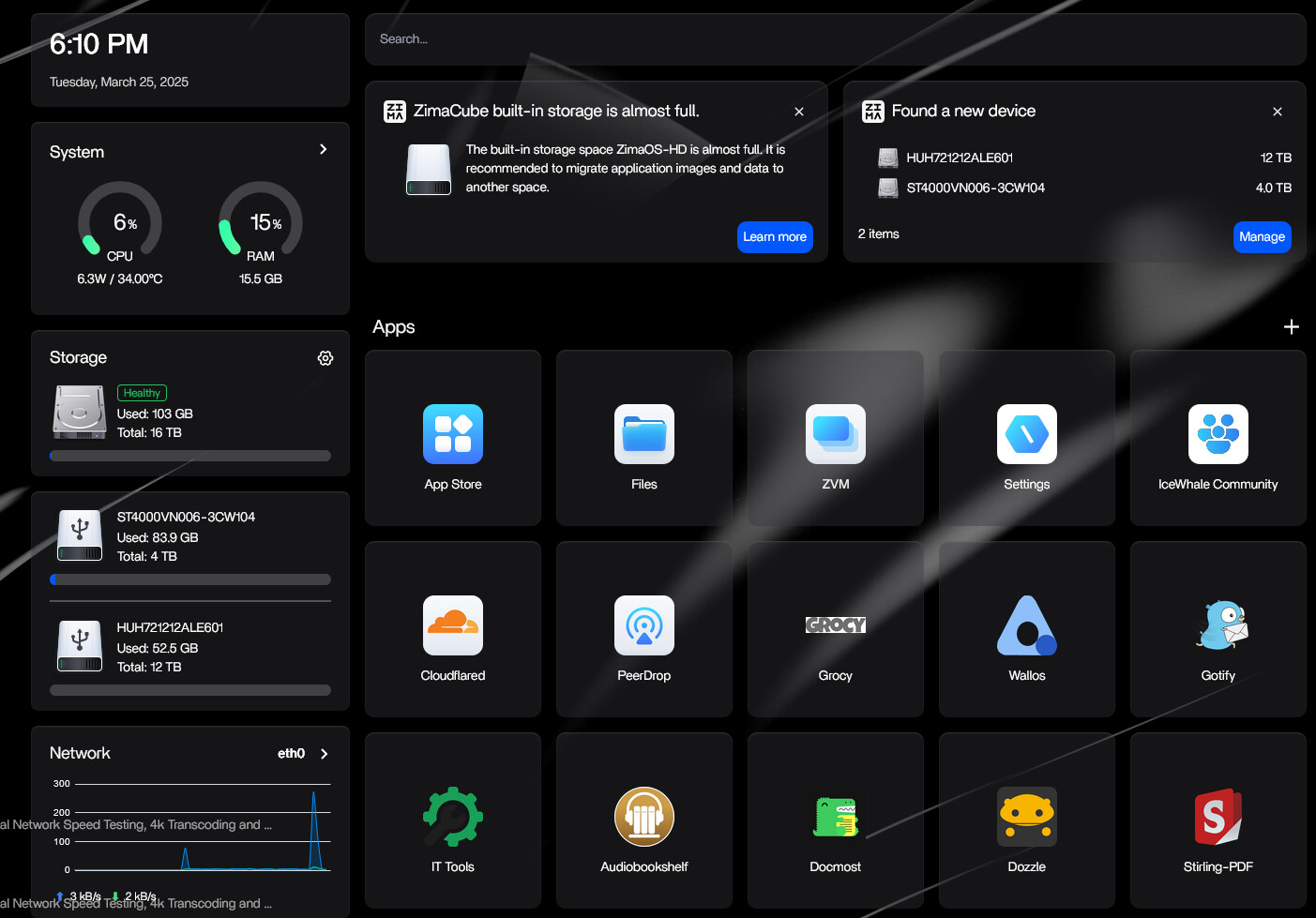
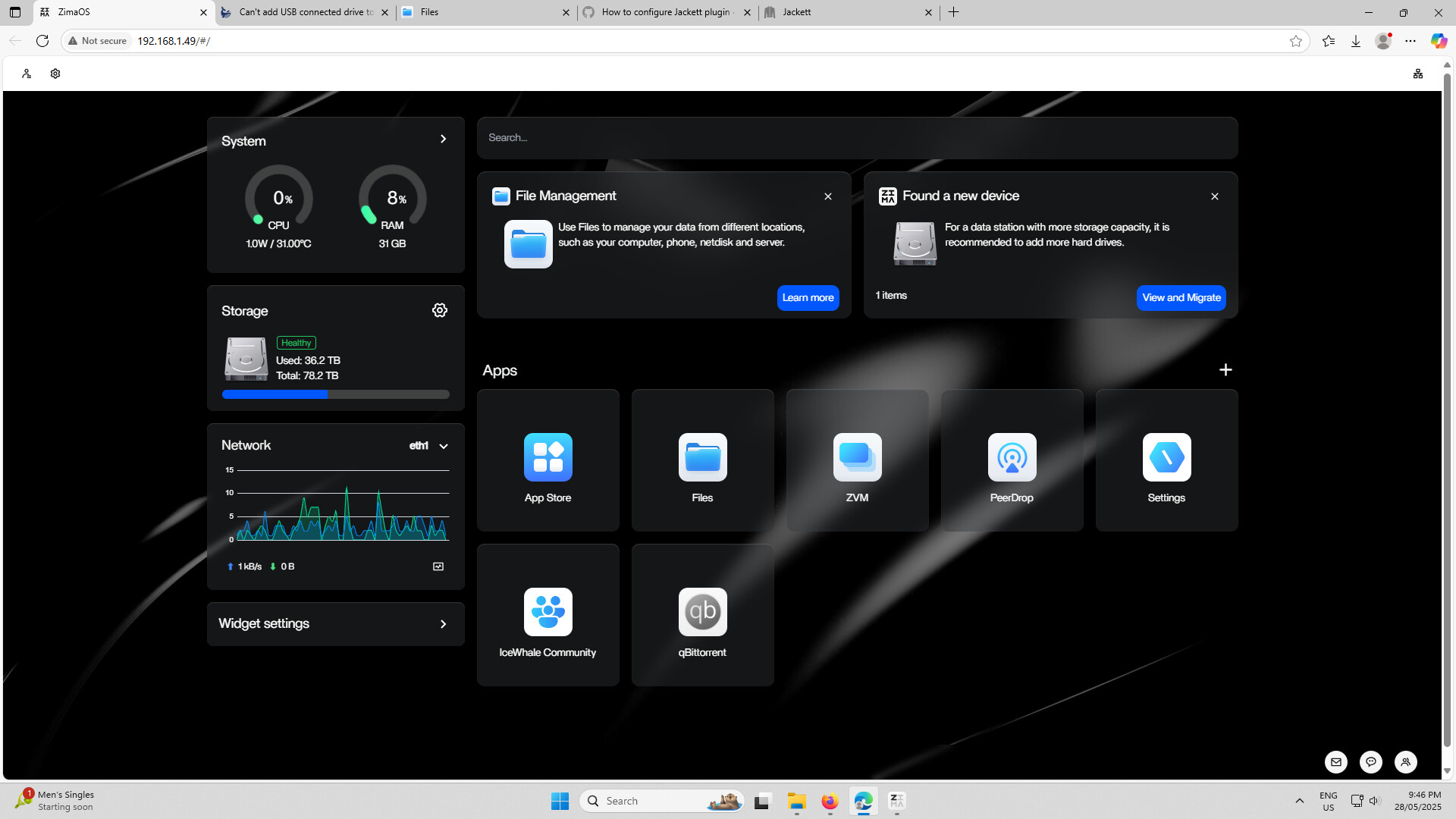
In fact, after the USB is automatically mounted, it will be displayed directly in the system. You can first confirm whether the USB has been mounted correctly. On the left side of the dashboard, you can see the USB capacity display. If it is not mounted normally, you can inform us of the USB disk format and we will check it.
I have a USB external enclosure (cuz good luck finding eSATA enclosures) Connected to my Dell Optiplex 9020. As is shown, the system recognizes the 2 drives, added them to the total storage, shows all drives as near empty (left panel) but also says built-in storage is almost full.
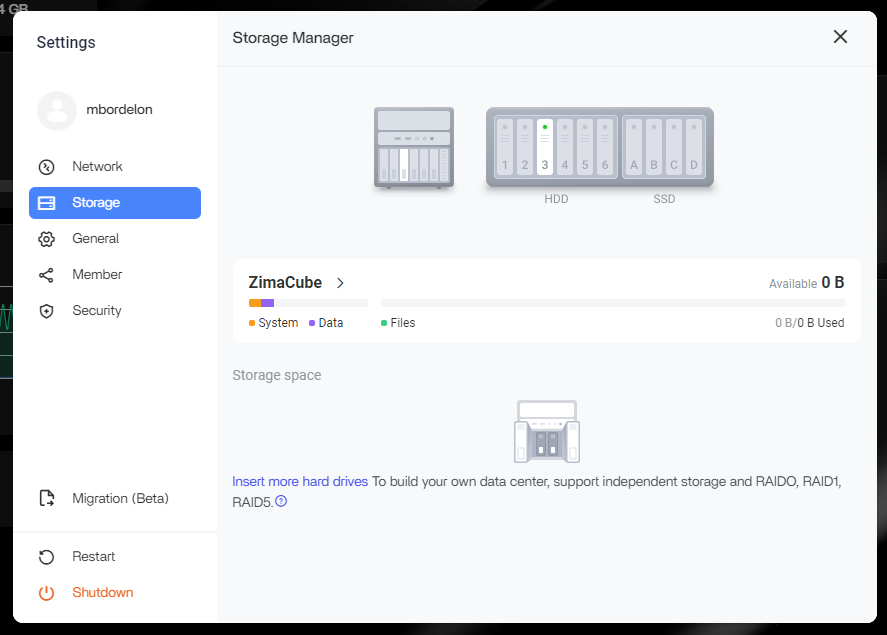
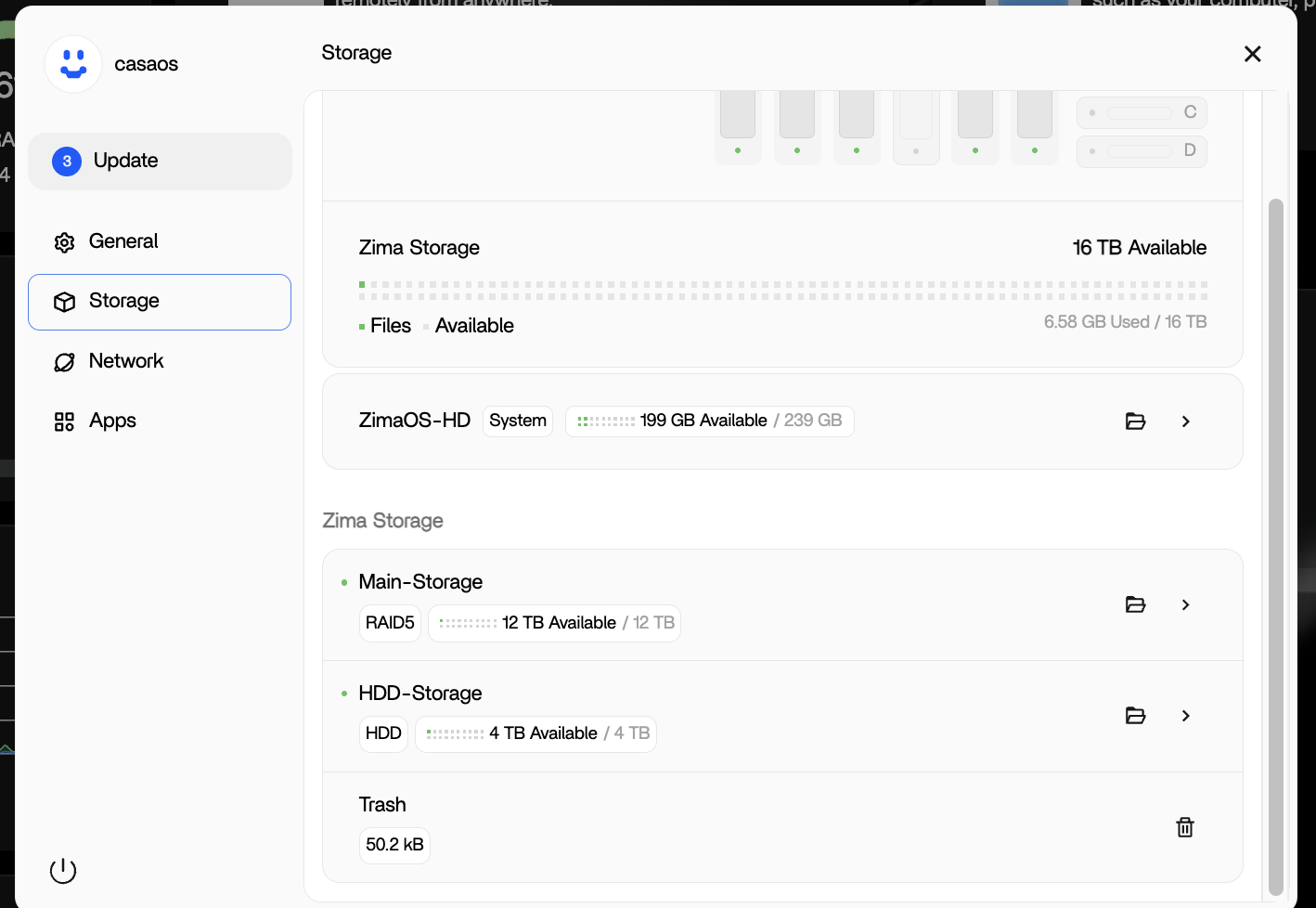
In the storage panel it only recognizes the 12T drive and doesn’t add it to storage.
Prior to adding the 4T drive in the enclosure the system would recognize the 12T and add it to storage, BUT it still claimed full storage. Are you saying @LinkLeong that it should seamlessly just continue writing into the availible usb storage? Cuz that is not what it is telling me.
Since installing Apps to the usb storage doesn’t seem to be an option can Symlinks be used for storage?
Issue one, mounting and enabling. It looks like ZimaOS correctly recognizes the drives; you need to check it in the Files app to see if the drive is available. Also, some uninitialized drives need to go through the formatting and enabling steps in settings before they can be used.
Issue two, Does adding an external drive result in freeing up space on the system disk? The answer is no. The system disk is always occupied unless you manually migrate or move your data to a USB drive.
Further reading.
Some disk formats are supported by default and do not need formatting.
Hello, thank you for sharing. I have added a USB external drive with USB 3 and ZimaOS doesn’t show it attached. I wanted to use it as an external backup for my ZimaOS.
Hey, why not give us a screenshot of your expectations and the reality? To locate issues, the more images, the better. Even take a screen record of the reproducing issue process.
Also, the specs and the version are important. Attach them here.
Hello uglost!. there was nothing to show therefore I didnt take a screenshot. After I did some testing I saw the following. The USB I plugged in was a USB case enclosure with a Samsung 2tb SSD drive and nothing came up or showed that the drive was plugged in. I plugged a regular USB drive and I can see that USB drive if Files. It maybe a drive issue, I dont know. Thanks for you support
We need to build a list of usb supported devices I tried two DAS cases QNAP tr-004 and Terramaster D4-320 dont shows the drive. A Simplecom SE482 SuperSpeed USB Dual Bay 3.5" SATA Hard Drive RAID Enclosure USB-C RAID 0/1, JBOD works and had 2 x 10tb giving 20TB showing up
ZimaOS is designed primarily for Zima devices, ensuring optimal performance and support. While we’ve made ZimaOS available for third-party hardware, compatibility with non-Zima accessories (like USB enclosures) may vary.
Currently, we don’t maintain an official list of supported third-party USB devices, but we’d love to collaborate with the community to create one! If you’d like to help, feel free to start a forum thread or wiki page where users can share their tested devices (like the Simplecom SE482 that worked for you). This way, everyone can benefit from collective experience.
Let us know what you think about it—we appreciate your initiative!
To Follow up on the USB storage, I looks like its not a hardware issue, As on the QNAP TR-004 has a blue LED to say its connected and is active. I had to format the drives in Windows disc manager (No Drive letter required until its plugged back into windows) and then plug the USB storage back into ZimaOS. 4x 4TB drives are added to the Total Storage in RAID 0, currently 78TB, but can’t add to main storage (JOBD)?
Would be great to be able to add / Format drives in the native filesystem in the UI, add a highspeed drive / JBOD to the main storage? Large backup is now posable.
We are currently improving ZimaOS to make it more geared towards general-purpose x86_64 machines, not just Zima devices, so your expectations and sharing of software features will be very helpful in shaping our products. Can you tell us about your real-world workflow? And what are your expectations for the storage panel? Sketches, ideas… all are welcome.
Same here. Terramaster D4-320 with four 6TB HDs. ZimaOS installed on a MiniPC is able to see the drives in their USB-connected case (local ZimaOS bash shell shows the four disks with “fidsk -l”, each formatted as btrfs), but they DO NOT show up in Storage.
My experience with a Fantec 3.0 enclosure housing 2× 2TB WD drives was that I first had to format the disks in DSM using ext4 before they were correctly recognized by ZimaOS. However, the setup proved unstable — during copy operations one or both drives would occasionally disconnect. Even when configured in hardware RAID0 within the enclosure, stability issues persisted.
Eventually, I decided to install the drives directly via SATA into my backup system and formatted them in BTRFS using OMV with a software RAID0. Later, I reconnected them through the Fantec 3.0 enclosure in JBOD mode to ZimaOS, and surprisingly, the system recognized them as RAID0 along with all the existing data.
Since then, I’ve been using this setup as an external archive for Immich and Jellyfin. It has been running very reliably without any interruptions or disconnections.
The good thing is that I can simply connect it to DSM and it gets recognized, even though it’s in Btrfs RAID0 format. Normally, when you plug in a new USB drive to DSM, it can only be formatted as ext4 or FAT.
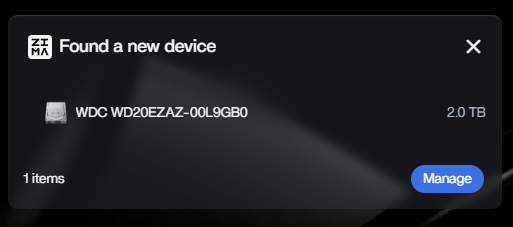
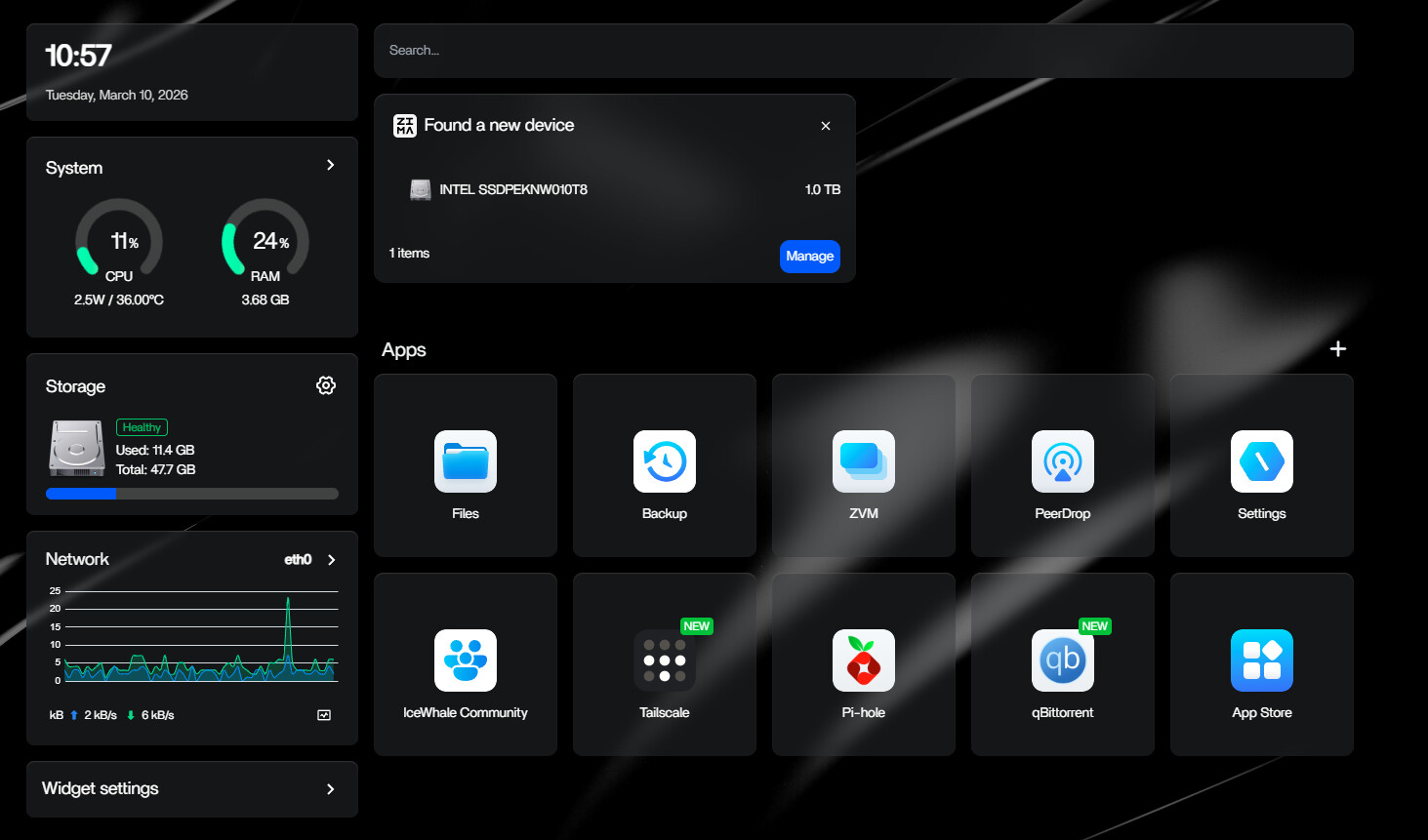
Similarly my drive shows up under “Found a new device” but when I click manage nothing useful happens. In file manager clicking External doesn’t show anything for USB connected devices. Furthermore, with SSH console executing lsblk I can see the drive, but am unable to mount it. I’ve tried other USB media - everything from a flash drive to a 20TB HDD can’t be added despite being discoverable
This is really disappointing for a core feature of a NAS operating system. I’m not trying to do anything fancy with the drive, I just want to store backups on it. In no world will I pay money for an OS that can’t recognize USB media. There’s nothing wrong but if charging money for an OS nor selling hardware, but if the vision of the team is “not our device not our problem” when it comes to something so simple I have to believe the longevity of the company is questionable
USB devices in ZimaOS are normally auto-mounted. If the drive appears but is not mounted, it is usually because the disk has no filesystem or the filesystem is not supported.
Could you please run the following commands via SSH and share a screenshot of the results?
lsblk
lsblk -f
This will help us check the disk status and filesystem so we can better diagnose the issue.
it should be made obvious in the UI that drives need to be formatted correctly to be used as part of the storage pool. And it should also be an option in the UI to format drives for storage use, with proper warnings that the existing data on the drive will be erased.
my drive shows up under “Found a new device” but when I click manage nothing useful happens.
For clarity, I already did wipe the drive and set it to ext4 a couple of times and rebooted my mini pc with ZimaOS, but the 4TB drive from the Orico DS500U3 USB enclosure still doesn’t properly work in the OS.
I thought it would be helpful to post my results on these commands too
root@ZimaOS:/root ➜ # lsblk
NAME   MAJ:MIN RM   SIZE RO TYPE MOUNTPOINTS
loop0    7:0    0   208K  1 loop
loop1    7:1    0   4.5M  1 loop
loop2    7:2    0   1.1M  1 loop
loop3    7:3    0   1.1M  1 loop
loop4    7:4    0   208K  1 loop
loop5    7:5    0   4.5M  1 loop
sda      8:0    0 238.5G  0 disk
├─sda1   8:1    0    32M  0 part /mnt/boot
├─sda2   8:2    0    24M  0 part
├─sda3   8:3    0     6G  0 part /
├─sda4   8:4    0    24M  0 part
├─sda5   8:5    0     6G  0 part
├─sda6   8:6    0     8M  0 part
├─sda7   8:7    0    96M  0 part /var/lib/rauc
│                                /var/lib/zerotier-one
│                                /mnt/overlay
└─sda8   8:8    0 226.3G  0 part /var/log
                                 /media
                                 /var/lib/libvirt
                                 /var/lib/icewhale
                                 /var/lib/extensions
                                 /var/lib/docker
                                 /var/lib/casaos
                                 /var/lib/bluetooth
                                 /opt
                                 /DATA
                                 /var/lib/casaos_data
sdb      8:16   0   3.6T  0 disk
└─sdb1   8:17   0   3.6T  0 part /var/lib/casaos_data/.media/Drive1_4TB
                                 /DATA/.media/Drive1_4TB
                                 /media/Drive1_4TB
nbd0    43:0    0     0B  0 disk
nbd1    43:32   0     0B  0 disk
nbd2    43:64   0     0B  0 disk
nbd3    43:96   0     0B  0 disk
nbd4    43:128  0     0B  0 disk
nbd5    43:160  0     0B  0 disk
nbd6    43:192  0     0B  0 disk
nbd7    43:224  0     0B  0 disk
zram0  252:0    0     0B  0 disk
zram1  252:1    0     0B  0 disk
zram2  252:2    0     0B  0 disk
nbd8    43:256  0     0B  0 disk
nbd9    43:288  0     0B  0 disk
nbd10   43:320  0     0B  0 disk
nbd11   43:352  0     0B  0 disk
nbd12   43:384  0     0B  0 disk
nbd13   43:416  0     0B  0 disk
nbd14   43:448  0     0B  0 disk
nbd15   43:480  0     0B  0 disk
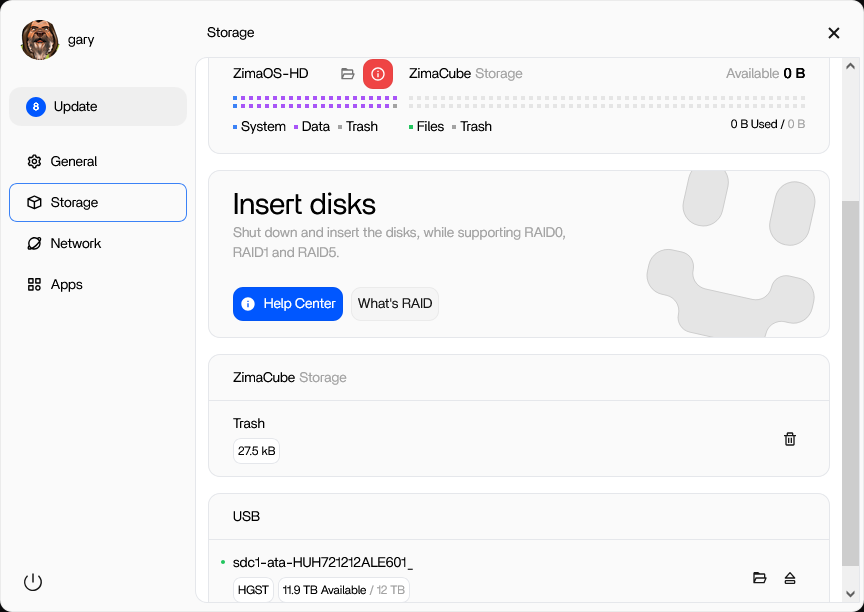
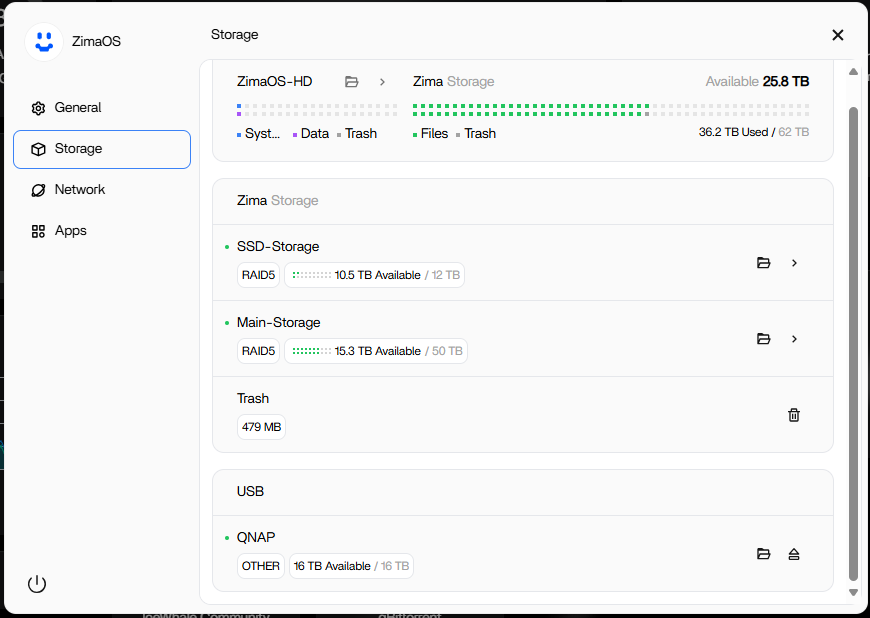
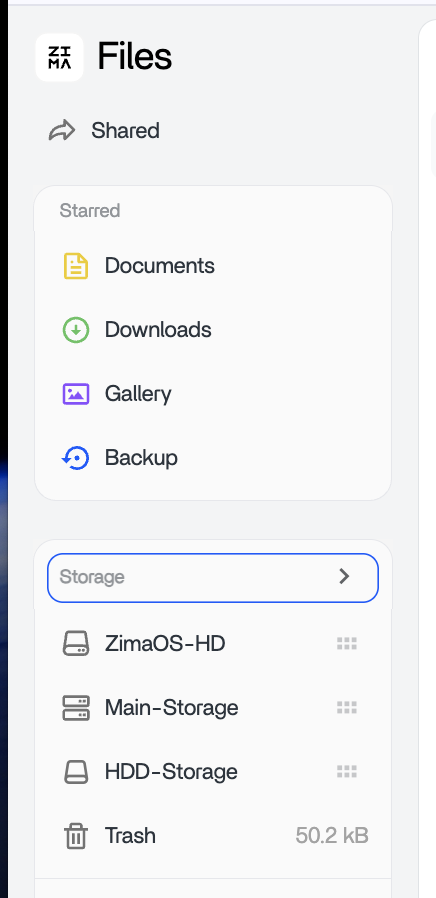
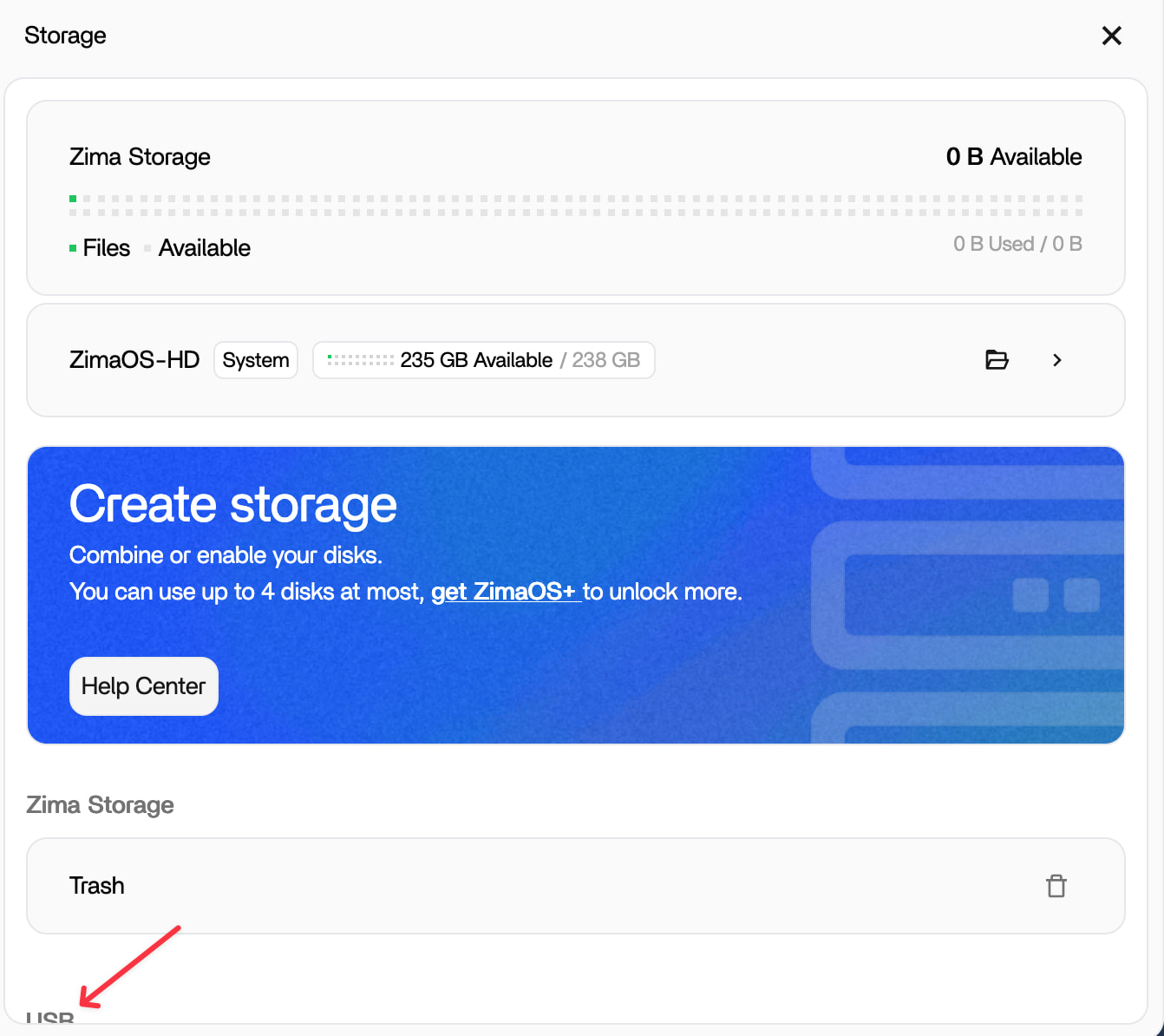
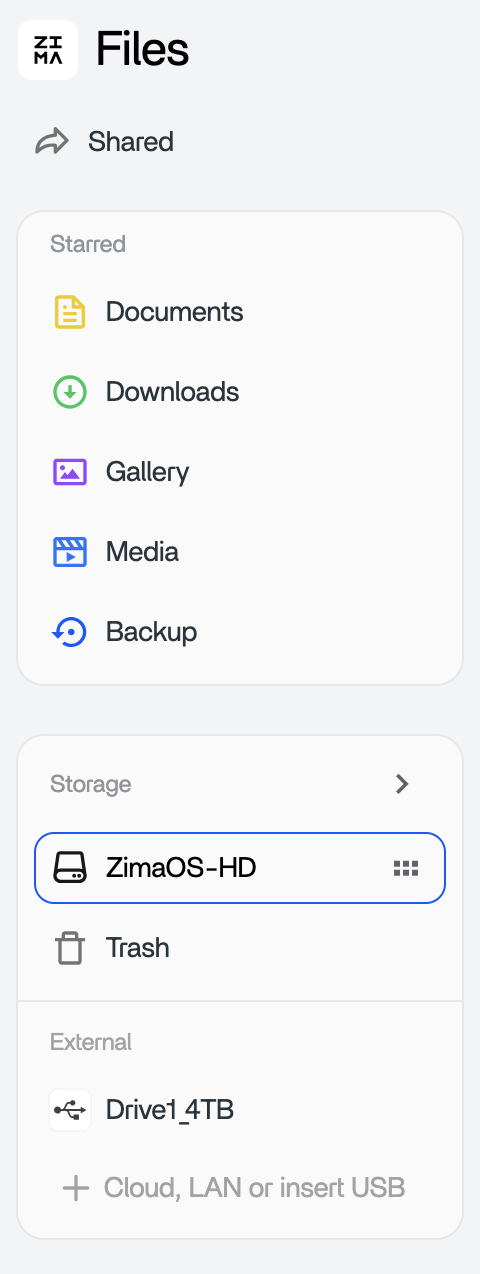
The command shows that the 4TB hard drive has been mounted. Could you please provide screenshots of the settings-storage interface and the left sidebar of the files interface?
Yes, seems that I didn’t notice USB subsection down there, sorry, wasn’t very visible I guess (as in pic. 1)
So basically formatting to ext4 and rebooting the device made the drive connect if anyone is having similar issues.
But still it is recognized as an external USB drive and not sure if it is possible to create a RAID formation out of these, but it will be greatly appreciated because there is no way to connect the drive via something else than USB to the mini pc.