Thanks, Spider. I’ve decided to step back from the Big Bear app store, and this is my last post about it.
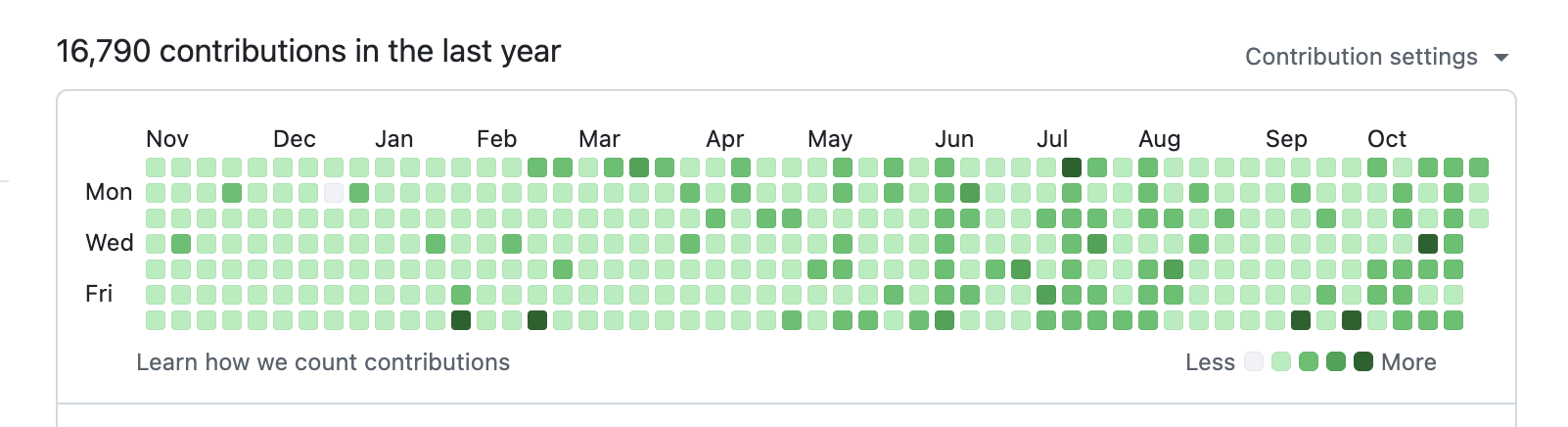
I’ve spent thousands upon thousands of hours building, maintaining, testing, troubleshooting, and contributing to open-source projects. I’ve been part of the GitHub community since 2011, long before AI coding assistants existed. I’ve worked on Big Bear every day, sometimes 6 to 12 hours a day, just maintaining it. I even kept it maintained while I was on vacation. My GitHub shows 16,790 contributions across my projects in the last year, with work on almost every single day:
And do you know what I’ve received for most of that work? A thank you.
I’ve received countless thank-yous over the years, and I appreciate every single one. If I had received money for every thank-you or acknowledgment, I might have made a decent living from the time I’ve invested. But making money or collecting recognition was never why I started doing this.
I built Big Bear because I wanted to support an incredible community and help people install and use self-hosted applications more easily.
I spent years writing Dockerfiles, scripts, and configurations by hand. I manually updated Docker images one version at a time, tested deployments, fixed problems, and repeated that process over and over.
I even took things further by creating a YouTube channel to help people learn how to install and use these applications.
I didn’t need AI to do any of this. I learned how to do it myself, and I have years of GitHub history and public YouTube videos documenting that work. Today, I use AI because it saves time, not because I don’t know how to develop software.
You seem to be overlooking the years of work that went into Big Bear before your app store existed.
Discovering applications
How exactly do you expect app-store maintainers to discover new projects?
Are we supposed to magically know every open-source application that exists?
We discover projects through Reddit, GitHub, other app stores, community discussions, user requests, and upstream developers. That’s how I’ve discovered software for years, and you’ve openly acknowledged doing the same thing.
The applications you’ve mentioned are publicly discoverable through their upstream projects or other community resources.
If someone sees an application in another store, visits its upstream repository, and creates their own deployment configuration, why would discovering that application automatically entitle the other store’s maintainer to credit?
I’ve never encountered a general requirement in open-source licensing or copyright law that someone must receive attribution simply for introducing another developer to a publicly available application.
Original code, documentation, and other protected contributions are different. I respect those contributions and their licenses.
But discovering an application doesn’t make you its owner.
Think about what you’re proposing. Would IceWhale need to acknowledge every person or website that helped it discover a project? Would every software developer have to document the entire chain of people who introduced them to an idea?
Where would that end?
I also want to be clear about the October applications. That batch involved a Zima catalog-gap comparison to identify applications missing from Big Bear. I’ve never had an issue discovering applications through other stores, and I don’t consider that something to hide.
The question is whether anyone’s original implementation was improperly copied, not where an application was first discovered.
Here’s something else I find troubling about your accusations. Since this dispute began, I’ve examined how many other projects and app stores use Big Bear’s work. I’ve found numerous examples of our configurations, scripts, and generated files being reused elsewhere.
Some developers credit Big Bear. Others don’t.
I’ve never felt the need to track those developers down and publicly accuse them of stealing from me merely because they benefited from my work. That’s part of what makes the open-source community valuable.
The personal attacks
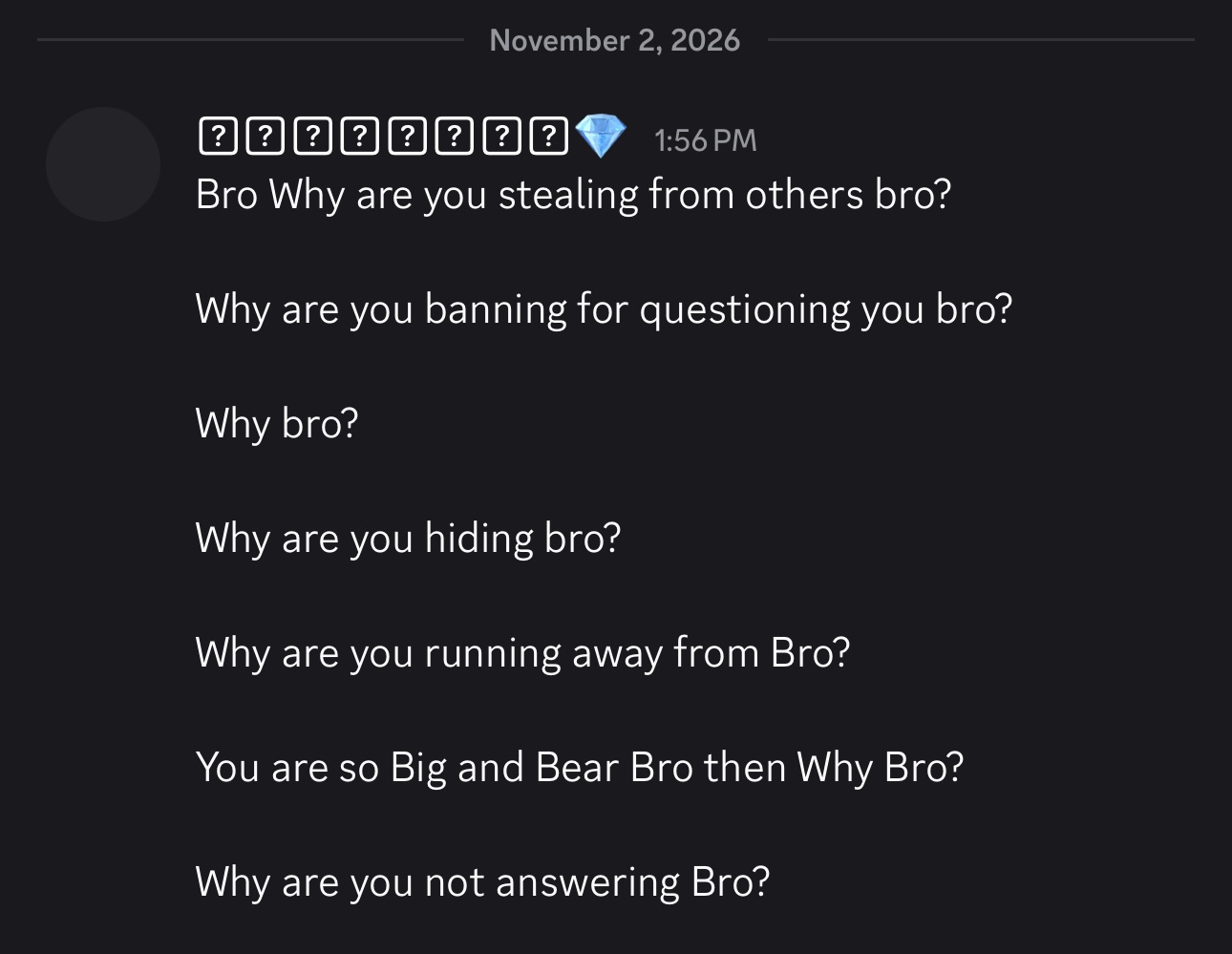
You’ve questioned my abilities, accused me of lying, mocked my work, and called me names: “What a loser” and “self obsessed and childish.” You also brought this dispute to me on Discord. In this thread, you said you’d sent one short message. Later that same day, after posting that, you posted this in my Discord:
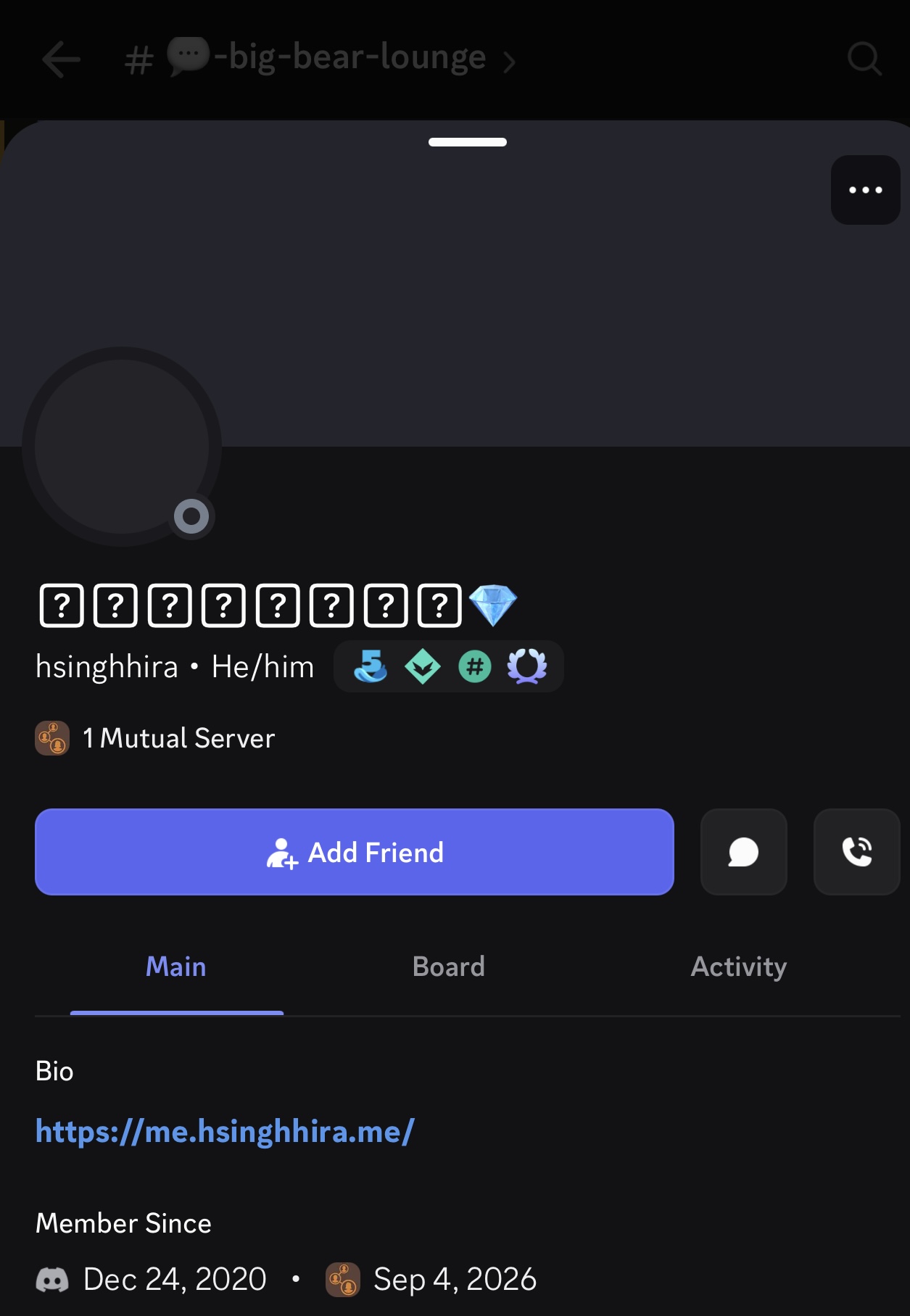
The sender’s Discord profile, username hsinghhira, linking to your site:
You then publicly criticized me for banning you.
Big Bear Discord is a community I’ve built and maintain. I’m happy to receive constructive criticism, discuss technical issues, and help people resolve problems. But I’m not obligated to host someone who is publicly calling me a thief and insulting me.
Disagreeing with my work is one thing. Making repeated personal attacks is another.
If I were acting as a moderator here and any member spoke to another the way you’ve spoken to me, I would have stepped in. Personal attacks don’t belong in any community. I’ve held back because I’m a party to this dispute.
But someone should have stepped in. “Stop lying,” “What a loser” and “self obsessed and childish” are still up in this thread, and no moderator has addressed any of them. When personal attacks go unchecked, they escalate, and that’s a big part of how this thread got where it is.
What has hurt the most
And now I want to address something that has bothered me even more than the accusations themselves.
I’ve spent years helping hundreds, if not thousands, of people throughout the open-source, CasaOS, and ZimaOS communities.
I’ve answered questions, troubleshot problems, helped people install software, created Docker images, written scripts, developed applications, maintained repositories, and published tutorials. I’ve also spent my own time moderating and helping people right here in this community.
I’ve invested thousands of hours of my own time and considerable personal resources into helping people, asking for very little in return. I’ve always tried to be professional while doing it.
I’ve helped people I didn’t know, people who were just getting started, and people who needed assistance getting their systems working. I’ve never kept score or expected anyone to repay me.
I did those things because I enjoy helping people and because I believe that’s what a community should be about.
And what has genuinely hurt me throughout this situation is how few people from that same community have spoken up while I’ve been repeatedly accused of stealing and personally insulted.
It hurts that so many people I’ve helped over the years haven’t spoken up. People I’ve spent my own time helping, sometimes for hours, without ever asking for anything in return.
That hurts, and I would be lying if I said otherwise.
I’m not asking anyone to blindly defend me, take my side without evidence, or give me special treatment because I’ve been around longer.
I’m asking people to stand up for fairness, respectful treatment, and the principle that serious accusations should be backed by actual evidence.
If someone were publicly treating another contributor this way, I would hope the community would insist on those same standards.
I understand that not everyone wants to get involved in a disagreement. Some people may not have seen the discussion, and others may have been waiting for IceWhale to respond. I respect that. But understanding why someone might remain silent doesn’t mean that silence isn’t disappointing.
When you’ve spent years helping others without expecting anything back, and then find yourself in a situation where you could use a little support, the silence is difficult to understand.
Why I’m stepping away
This entire experience has made me seriously reevaluate where I’m investing my time and energy.
I didn’t make this decision lightly, and I didn’t make it until IceWhale responded. I waited for that response before deciding anything. I’ve supported the CasaOS and ZimaOS platforms with a huge amount of my time for years, and after reading it, I don’t feel that support has been appreciated.
I’ve spent years giving my time, knowledge, and resources to people and communities because I believed in what we were building together.
I still believe in open source, and I still enjoy helping people. That hasn’t changed.
But I don’t feel that same consideration, appreciation, and respect in this community anymore. There’s a difference between contributing freely because you love what you do and feeling like your contributions have simply become something everyone expects.
I’ve never required anyone to pay for my open-source or community work. Big Bear’s app stores and scripts have been free to use, and I’ve never expected recognition or special treatment.
But I don’t think expecting a little fairness and support when your integrity is being publicly questioned is asking too much.
Working on this 365 days a year has become a burden, and the stress of all this hasn’t been healthy for me. So I’m taking a much-needed break from open source and putting my time into other projects, where the work is appreciated.
To be clear, you didn’t run me off. This thread opened my eyes to how much of my life this work has been taking, and to how little that has counted when it mattered.
That doesn’t mean I’m turning my back on open source or the people who have supported Big Bear. It means I’ve thought seriously about how I’m spending my time, and I’m putting it where it’s valued.
I don’t believe contributing for years makes me more important than a newcomer. Everyone deserves respect, regardless of how long they’ve been involved. But I do believe that the time, effort, and contributions people have freely given to a community should count for something when their integrity is publicly questioned.
And I think communities need to consider something else. What happens when established contributors who have spent years giving their time freely become discouraged because personal attacks and unsupported accusations are allowed to dominate discussions? Doesn’t that also risk driving contributors away?
You repeatedly talk about the motivation of smaller app-store maintainers. I understand that concern. But what about the people who have already spent years contributing? Don’t their time, effort, and willingness to continue helping the community matter too?
Respect has to work both ways.
I have nothing against you maintaining your own app store. I genuinely encourage people to build their own projects, contribute to open source, and share their work with others. Big Bear offering the same upstream applications never erased your work.
You say you want respect for your time and effort.
So do I.
Stepping back isn’t an admission of anything. The record below shows what happened.
The technical record
You’ve asked me to answer publicly, so here it is, point by point. Big Bear’s repositories are private now, so links to them won’t open. Instead I’ve attached ente-signed-proof.zip. It holds the two commits GitHub created and signed on July 7, plus the Ente file from each. A short script checks GitHub’s signature and the file hashes, so anyone can confirm the dates and contents without access to my repositories and without trusting me.
Short version: Ente was requested, built and published by Big Bear on July 7, six weeks before your ZimaAppStore repository was created, and our passwords, converter output and description later showed up in yours. Our Stoat follows upstream and ran when I tested it. The October apps were found through a catalog gap check and other sources and built from upstream, with every developer credited.
I’ve also noticed that your own Ente configuration contains distinctive values and metadata conventions that were publicly documented in Big Bear before they appeared in your published repository.
Here is what happened, in order.
What the record shows
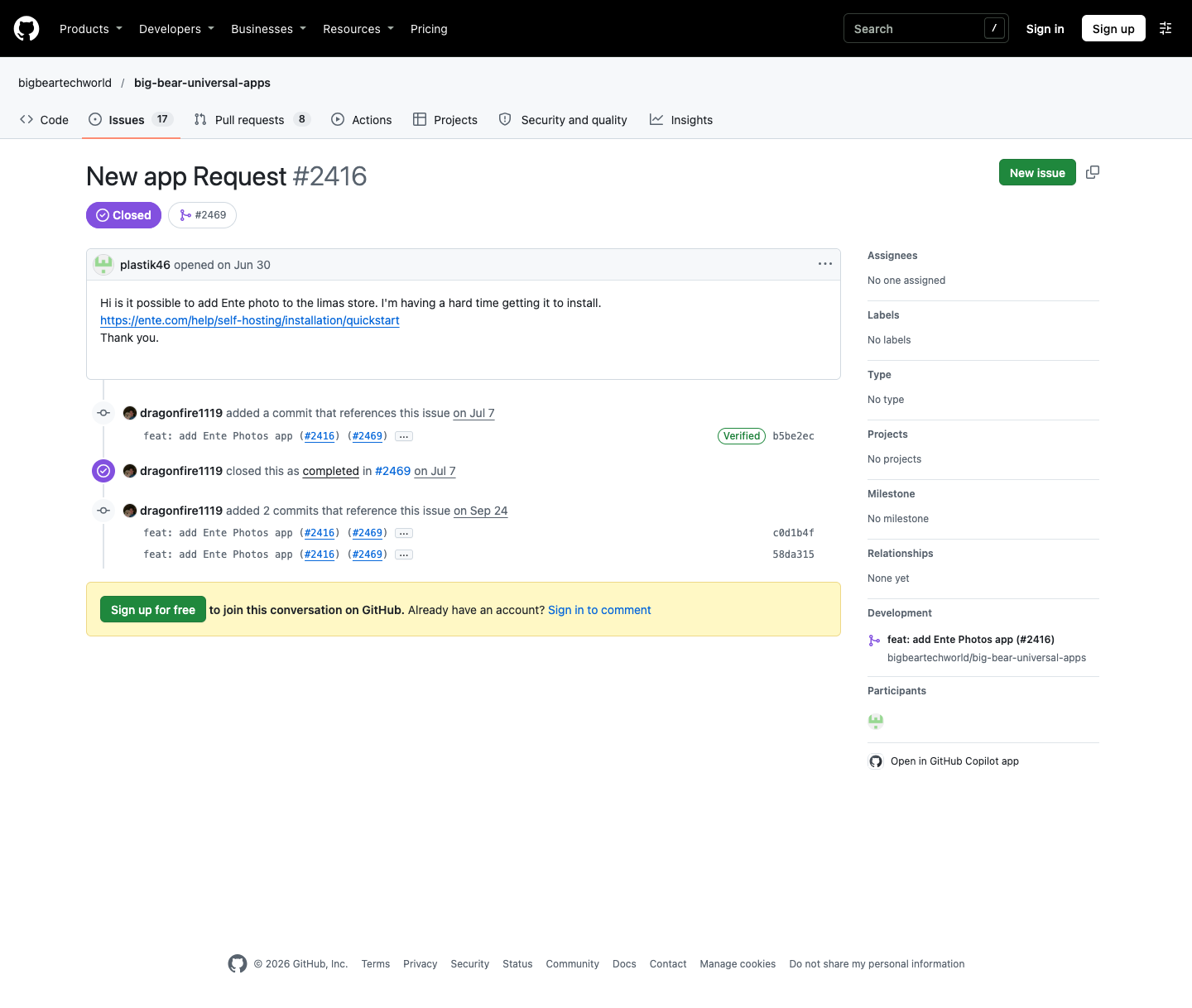
It started with a request. On June 30, 2026, a Big Bear user asked us to add Ente Photos (issue #2416):
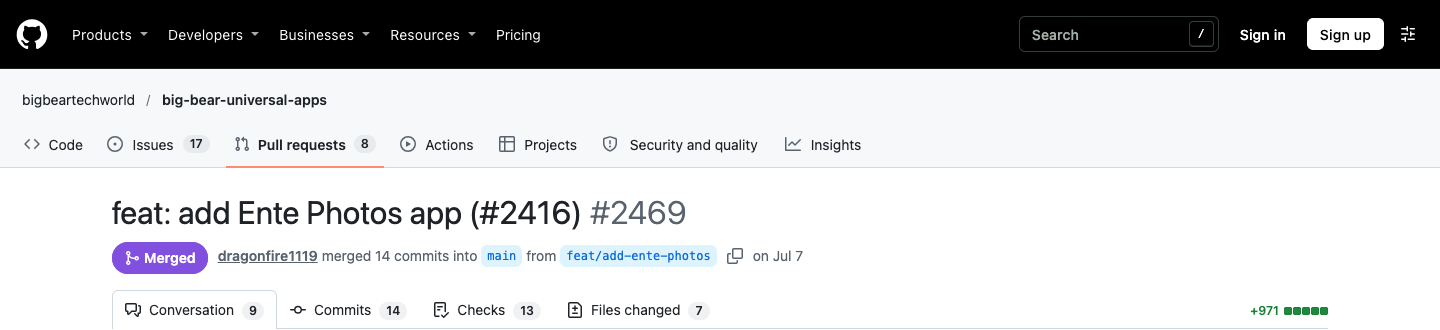
A week later, we built it. On July 7, the Ente pull request (#2469) was opened at 21:21 UTC and merged at 21:41 UTC. GitHub created and signed the merge commit, b5be2ec3, at 21:41:30 UTC, so the time doesn’t depend on anyone’s clock. Our tooling then synced the app out to the CasaOS store, and GitHub signed that commit, 3ce769d1, at 21:48:44 UTC.
Both signed files already set the database password to one beginning change-me-qE7Y and the MinIO password to one beginning change-me-minio-vH3p. They’re on lines 21 to 26 of the merged file in the zip.
When Big Bear publishes an app for CasaOS, our converter script, convert-to-platforms.sh, writes a description for every environment variable in a set format: Container Variable: ENTE_DB_HOST, Container Variable: ENTE_DB_PORT, and so on. Nobody types those by hand. The script generates them, and they start on line 40 of the signed CasaOS file.
Six weeks later, your store appeared. GitHub records your ZimaAppStore repository as created at 05:23 UTC on August 20, and Ente is in its very first commit: First · HSinghHira/ZimaAppStore@b6bfca4 · GitHub
That Ente has the same two passwords from our July 7 merge, word for word. It also has our converter’s output: Container Variable: ENTE_DB_HOST and the lines after it, the same text our script writes. Ente is the only app in your store that ever had those lines. On September 15, they were removed.
But not everything was removed. Your Ente also carried our app description, word for word: “Ente is a self-hosted, end-to-end encrypted platform to store, share, and rediscover your photos and videos across all your devices.” We published that sentence on July 7. It’s on line 212 of the signed CasaOS file.
On September 15 it stayed, and it went into your new EnteGarage and EnteSeaweedFS apps as well. It’s still in your ZimaAppStore today: ZimaAppStore/Apps/Ente/docker-compose.yml at f188681795ed58b96ab66923722445d1d612342c · HSinghHira/ZimaAppStore · GitHub
The encryption keys and image digests match too, but I’m not counting them. The keys are Ente’s own published defaults, and anyone pinning those images that week would get the same digests. The passwords, the converter text and the full wording of that description are different. They’re specific to Big Bear, and Big Bear published them first. Before Big Bear’s repositories went private, a GitHub code search for that full sentence found it only in Big Bear’s own repositories. The copy in your file is linked above.
Then came your explanation. You’ve said you built Ente in May or June in a repository called CasaOSApps, which you later deleted. I’m not saying that repository never existed. But GitHub returns a 404 for it, and I can’t verify what was in it or when. The earliest record of those values is Big Bear’s July 7 merge, signed by GitHub.
Then came Stoat. You said both of our Stoat apps fail the same way, so I tested both on November 2 and again on November 3 with Docker 29.8.2 and Compose v5.5.0. I used our apps/stoat/docker-compose.yml at commit 6a77f10 and your Apps/StoatChat/docker-compose.yml at commit 9e4685a. The only changes were local ports, no host ports for LiveKit, local data folders on yours, and running our web image as linux/amd64 because it has no arm64 build.
Ours came up cleanly: all 17 services, with 15 running and 2 one-time setup jobs finished. The API answered through Caddy, account creation and login worked, and the WebSocket connected with the login token. Yours never got that far. Every Stoat backend service (api, events, autumn, january, gifbox, crond, pushd and voice-ingress) crash-looped on startup with missing field url, an error that comes from your own Revolt.toml. They behave differently because they are different configurations.
So here is where the record stands. Ente was requested from Big Bear, built by Big Bear, and published by Big Bear on July 7. Six weeks later it showed up in your first commit with our passwords, our script’s output, and our description, and that description is still in your store today. And your claim that both Stoats fail the same way doesn’t hold up: yours crash-looped, and mine started and worked when I tested it.
So the claim that I copied your Ente is wrong, and the files show it.
Your latest questions
You’ve asked how Big Bear’s apps were developed, so here are direct answers.
You asked why I haven’t responded. I did, right here. On November 1, the day you opened this thread, I answered in posts 4 and 7 with the Git history and the Ente pull request, and I answered your GitHub issue the same day. Those repositories are private now, so the signed proof is attached instead.
The 22 apps. The list came from an AI-assisted Zima catalog gap comparison, plus Reddit, GitHub, blog posts and AI-assisted web searches, as I said above. Each Big Bear configuration was then written against the project’s own upstream Compose files and documentation. Finding apps in a batch isn’t the same as copying configurations.
Stoat. You said the original developer only provides a basic Compose file and leaves the supporting services to whoever deploys it. That isn’t the case. Stoat’s official self-hosted repository ships the full stack: api, autumn, caddy, createbuckets, crond, database, events, gifbox, january, livekit, minio, pushd, rabbit, redis, voice-ingress and web: self-hosted/compose.yml at 4394499561b05142872d80562daaa3ecf489e49b · stoatchat/self-hosted · GitHub
Big Bear’s Stoat uses those services, plus one config helper for LiveKit, because it follows upstream.
Variables and secrets. The variables in Big Bear’s apps follow each project’s own documentation and .env examples.
Default secrets. CasaOS and ZimaOS install the values written in an app’s Compose file, and there’s no way to require users to enter their own credentials before installing. WisdomSky documented this in July 2023: “The current implementation in CasaOS is that everything must be hard-coded into the docker-compose.yml and there’s no way for the user to provide these required information beforehand.” [Feature Request] Allow requiring user to fill-up custom environment variables before install · Issue #1248 · IceWhaleTech/CasaOS · GitHub
That request was merged into an older one that is still open today: [Feature Request] Variable input in Before Install Tips · Issue #1101 · IceWhaleTech/CasaOS · GitHub
That’s why community stores ship default values that users are expected to review and change. BookOrbit’s own documentation requires POSTGRES_PASSWORD, JWT_SECRET and SETUP_BOOTSTRAP_TOKEN and tells users to set their own long random values. You said SETUP_BOOTSTRAP_TOKEN isn’t needed because the app generates its own. BookOrbit’s code says otherwise. In production it refuses to start without one: “SETUP_BOOTSTRAP_TOKEN is required in production.” Its Compose file marks JWT_SECRET and SETUP_BOOTSTRAP_TOKEN as required too: bookorbit/server/src/config/env.validation.ts at 76450d6ddd2e2b94481695ce069cac1f6a5a59f3 · bookorbit/bookorbit · GitHub bookorbit/docker-compose.yml at 76450d6ddd2e2b94481695ce069cac1f6a5a59f3 · bookorbit/bookorbit · GitHub
Those variables are in Big Bear’s BookOrbit because upstream requires them. And the values were never the same. You said Big Bear’s version had the same hardcoded token as your first one, but none of Big Bear’s BookOrbit values have ever appeared in your BookOrbit. Big Bear’s JWT_SECRET begins cd94b64e, and yours never did.
Shipped defaults are meant to be replaced, and making that easier for users is worth doing. The goal is for every install to end up with its own credentials, without hiding them from the person who installed it. When an app refuses to start on a placeholder, shipping one makes users set their own value. That’s how Big Bear updated Yuvomi when its maintainer raised this on October 25, within two days.
What maintaining Big Bear involved. Big Bear has never been just one app store. It has been a catalog of more than 490 apps, maintained since 2023, that I converted and published for six platforms: CasaOS and ZimaOS, Portainer, Dockge, Runtipi, Cosmos and Umbrel. It came pre-added to ZimaOS, so it ran on a very large number of systems, most of them owned by people who just wanted their apps to keep working.
At that scale, every decision was a tradeoff. I didn’t get to ask only whether a change was better in theory. I had to ask what it would do to everyone already running that app, and how many people it would leave confused or locked out. That’s the part of this work that doesn’t show up in a Compose file.
If something broke, I heard about it. You’ve suggested Big Bear’s apps don’t work and aren’t tested. With a store that came pre-added to ZimaOS, a broken app doesn’t go unnoticed. When something doesn’t work, people come straight to me on GitHub, Discord and YouTube. If Big Bear’s apps were as broken as you claim, I’d have had a flood of community members telling me so. The next point shows how quickly that happens: a change that only delayed updates brought hundreds of support requests. That’s the side of this work you aren’t seeing.
Why changes take care. Every change has to work for existing installs, not just new ones. Changing a shipped secret can break an install or lock someone out of their own data, which is why the Yuvomi update tells people with existing installs to keep their current database key when they update, because a changed key stops the database from opening. I’ve learned this the hard way. I once set Big Bear to wait three days before taking a new app release, so broken updates would get caught before they reached anyone’s server. It was a sensible safety measure. But users noticed their apps weren’t updating right away, and I got hundreds of support requests asking why. I removed the delay. A change that’s safer on paper doesn’t help if thousands of people experience it as something broken.
The same goes for credentials. When a password wasn’t easy to find, the first support request I got was “where is my password?” That’s why Big Bear kept defaults visible in the app settings, with install notes telling users to change them, so people can find and change their credentials without opening a support request.
Screenshots. None of the October apps includes screenshots, so none uses anyone else’s.
Credit to original sources. Every one of those apps names its upstream developer in its metadata, for example trackie-nz, Harsh Shah, useindelible and stoatchat.
The “bigbear-” names. Prefixing app IDs, service names and AppData folders is namespacing. It keeps Big Bear apps from colliding with other stores’ apps and containers on the same machine. It’s a practical convention, not vanity.
Staff, pre-installation and visibility. I’m speaking here as Big Bear’s developer, not for IceWhale. Questions about which stores come pre-installed and what standards IceWhale expects are theirs to answer, and I won’t answer for them. But IceWhale already gives independent stores visibility. Its Awesome Third-party Stores page lists community stores for anyone to import, including Play AppStore, Lintuxer’s store and Big Bear, and describes itself as “a community discovery page, not a formal endorsement list”: Community App Stores for ZimaOS: Third-Party App Collections | Zimaspace Docs
These lists are open source, and anyone can propose a store. The CasaOS list has received pull requests from ten different community members since 2023: Pull requests · IceWhaleTech/Awesome-CasaOS · GitHub
Big Bear started out the same way. It was seven weeks old when IceWhale added it to that list in September 2023, next to the other community stores: History for content/3rd-party-app-stores/list.md - IceWhaleTech/Awesome-CasaOS · GitHub
Your requests
A technical review. The evidence is attached. The Ente record above is backed by commits GitHub signed, and the attached file lets anyone check them without access to my repositories or having to trust me.
Removing the apps. I’ve stepped back from the store for the reasons I gave above, not because of this request. Nothing posted here shows that any of those apps were copied, and they were built from their own upstream projects.
My staff role. That’s IceWhale’s decision, not mine.
This is my last word on it
I won’t be reviewing any more material from you, and I won’t be continuing this conversation. The record is here for anyone who wants to check it. I’ve saved copies of this thread, your posts, your repositories, and everything referenced here, so if anything is edited or deleted, I still have it. If the accusations can’t be backed up, I think they should be corrected wherever they’ve been repeated.
Evidence
Because I’m also a community moderator, I’m speaking here as the developer of Big Bear, not on behalf of IceWhale. Any moderation decisions about this dispute should be handled without me.